
Session
Perspectives, Applications, and Open Problems in AI for Robots and Embodied Agents
– A community-building event
Organized by:
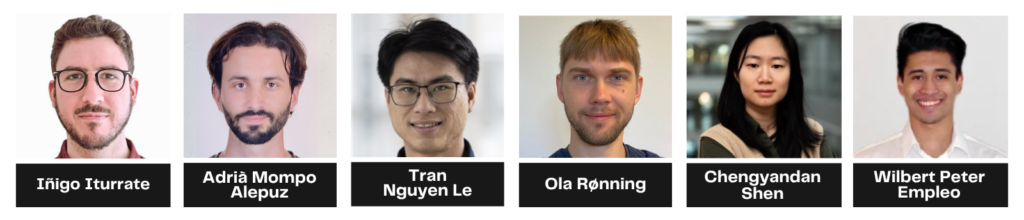
Thursday 8 October 11.00
Lead organizer: Iñigo Iturrate, Associate Professor, The Mærsk McKinney Møller Institute, SDU
Increasingly, AI is being applied to control robots and physical systems. This so-called physical AI opens new domains of application, including autonomous surgery, neurorobotics, rehabilitation, and automated manufacturing, and enables entirely new human-robot interaction paradigms.
Yet, physical AI faces unique challenges: Embodied agents must cope with real-world input noise, drift, and unmodeled dynamics. At the same time, robot applications are safety- and performance-critical, where the cost of errors is high and their allowable magnitude is small.
This workshop will provide insights into different perspectives, topics, and challenges faced by Danish robot learning researchers. This will serve as a springboard for breakout sessions around specific discussion topics. Through this discussion, we aim to bring researchers together and help establish a stronger sense of community.
Welcome (3 minutes)
Part I: Invited Talks (40 minutes)
3-4 talks on selected topics, each lasting 10-13 minutes, including a short Q&A. The topics of the talks are meant as framing remarks for the breakout session, serving as an outset for discussion.
Part II: Breakout Sessions (30 minutes)
Participants self-organize into small groups, where they discuss one of the following topics, based on their field(s) of interest:
The discussion should center on common research problems, experiences, directions of mutual interest, and avenues for collaboration.
Plenary Discussion (15 minutes)
Selected representatives from each group present their findings and these are discussed openly by the audience, along with a reflection on where to go from here, e.g., the establishment of an official robot learning research community in Denmark.
Concluding Remarks (2 minutes)
Adrià Mompo Alepuz, PhD student, Department of Electrical and Photonics Engineering, DTU:
Neuro-inspired AI for Safe Human–Robot Interaction
Tran Nguyen Le, Assistant Professor, Department of Engineering Technology and Didactics, DTU:
Are current Generalist Robot Policies really general? Promise and Reality!
Ola Rønning, Postdoc, Postdoc, DDSA Fellow, Software Quality Research (SQUARE), ITU:
Probabilistic Guarantees in a Physical World: What Can We Promise?
Iñigo Iturrate, Associate Professor, The Mærsk McKinney Møller Institute, SDU:
Why robots should learn to say “I don’t know”: Uncertainty-awareness and safety for physical AI
Intermediate: For attendees who have basic understanding or some experience with the subject but are not yet advanced.