
Session
Physics-Informed AI for Real-World Engineering
Organized by:
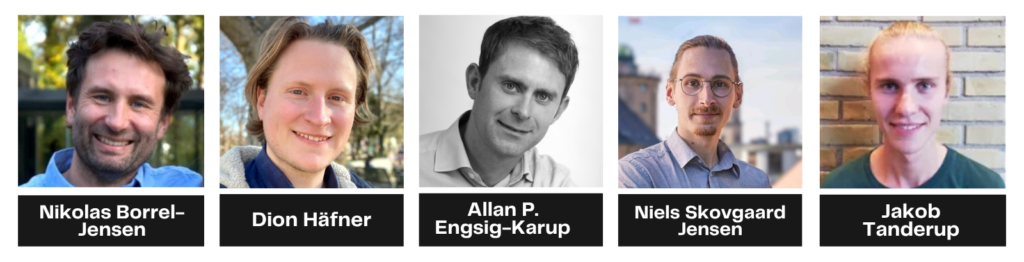
Thursday 8 October 11.00
Lead organizer: Nikolas Borrel-Jensen – Simulation Intelligence Engineer, Pasteur Labs
This workshop will be about scientific machine learning surrogates — including neural operator architectures based on transformers, DeepONets, graph networks, and diffusion models — and hybrid models, in which a numerical solver itself becomes a neural network layer. Both classes can learn to solve real physical problems, and their end-to-end differentiability makes them well suited to optimization and inverse problems.
The workshop opens with an introduction to the field, followed by two lightning talks from early-career researchers, and fosters active participation through live tutorials and a structured discussion. We assume familiarity with machine learning in general; no background in scientific machine learning or differentiable simulation is required.
The session is designed around an interactive tutorial with a short framing talk, two lightning talks and a closing discussion.
Icebreaker warmup (3–5 min)
A short warm-up among everyone in the room.
Landscape framing (10 min)
Nikolas Borrel-Jensen and Dion Hafner, Pasteur Labs.
Setting the scene: what Physics-Informed AI is, why it matters for engineering, and how differentiable programming and surrogate modeling fit together. Illustrated with a real-world case study.
Lightning talk 1: Differentiable electromagnetics for spacecraft design: learning inside the solver (10 min)
Niels Skovgaard Jensen, Industrial PhD Student, DTU Compute/TICRA
Lightning talk 2: Sensing with physics-informed neural networks (10 min)
Jakob Tanderup, Research Assistant, DTU Compute.
Live tutorial (30 min)
Narrated, end-to-end walkthrough of a small but complete engineering problem (1D/2D PDE). The presenter drives the notebook on screen; participants can follow along on a pre-loaded cloud notebook or simply watch.
Introduce Mosaic (https://github.com/pasteurlabs/mosaic) and show how physical solvers are wrapped as a reusable Tesseract component
–
Structured discussion (25 min)
A series of straw polls via Kahoot, inviting the audience to share a specific pain point or open question from their own research.
Intermediate: For attendees who have basic understanding or some experience with the subject but are not yet advanced.