
Session
The Future of Social Data Science: What Role Can it Play in Denmark and Beyond?
Second Edition
Organized by:
Thursday 8 October 15.15
Lead organizers: Arianna Pera, Postdoc, SODAS, University of Copenhagen and IT University of Copenhagen & Akhil Arora, Assistant Professor, Aarhus University, SODAS, and P1
The growing availability of large-scale datasets, combined with computational methods from network science, artificial intelligence, physics, and natural language processing, has opened exciting new possibilities for studying and understanding social phenomena. This has given rise to the interdisciplinary field of Social Data Science (also known as Computational Social Science).
Building on the success of our first session at D3A last year, this second installment brings together researchers, policymakers, data scientists, and practitioners to critically examine the role of data science and AI in society. With great power comes great responsibility: this workshop aims to engage all attendees in an open discussion of how data science can be used for social good, and what the most pressing questions are at the intersection of AI and society — both globally and in Denmark.
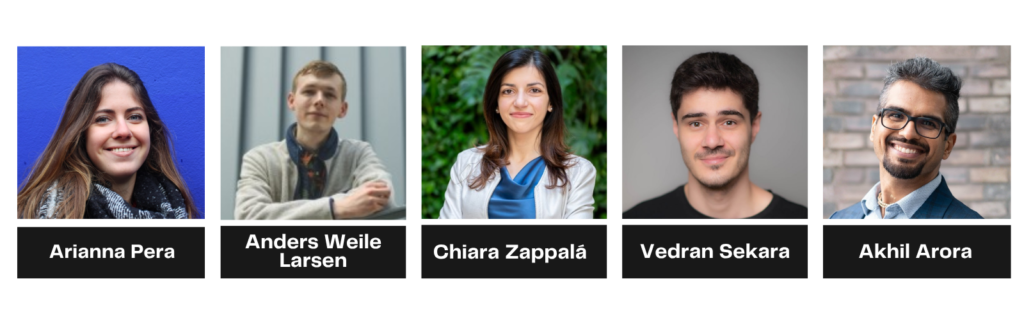
To spark discussion, five speakers will give brief talks on the key open questions, ethical dilemmas, and challenges in their work. This year’s focus is on public-interest applications of social data science, spanning humanitarian uses of data, the adoption of sustainable behaviors, the changing role of AI in science and research, explainability in NLP, and the study of human mobility. Facilitators will then guide a broader conversation with all participants on the problems social data scientists should prioritize, in Denmark and beyond.
Welcome (5 min)
5 x 10 min presentations (50 min)
providing discussion points on key issues and topics
Broad discussion with the audience (panel-style) (35 min)
facilitated by 2 moderators
Themes:
–
Macro-topics and speakers
Target Audience
The session is for practitioners, policymakers, and researchers with an interest in applying data science, computational social science, network science, and artificial intelligence methods for understanding social phenomena. The level will be intermediate: attendees should have a basic understanding or some experience with the subjects.
Outcome of the previous D3A session
Last year’s D3A session attracted around 40 participants from academia, policy, industry, and civil society, and generated an engaged discussion on the future of Social Data Science in Denmark and beyond. Through short provocation talks and facilitated audience discussion, participants reflected on key unanswered questions, ethical dilemmas, and opportunities for using computational methods to understand social phenomena.
The active participation and lively exchange of perspectives highlighted the value of continuing this conversation as a recurring forum for the Danish Social Data Science community.