
Deep Dive Workshop
Modern Statistics and Machine Learning in Data Science
Organized by:
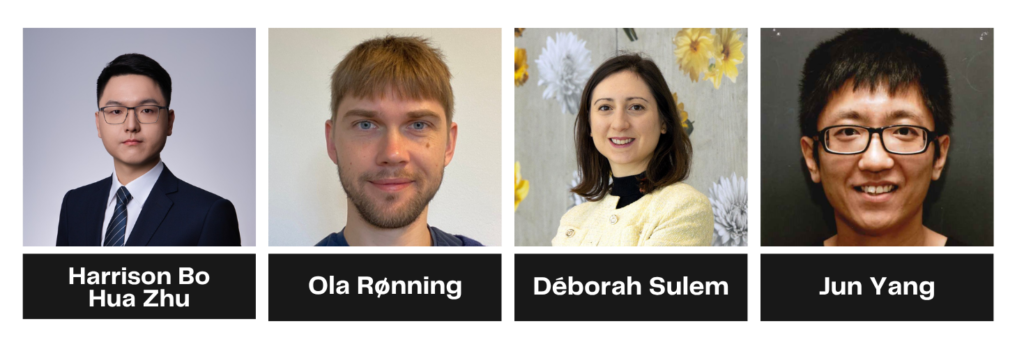
Friday 9 October 10.05
Lead organizer: Harrison Bo Hua Zhu, Assistant Professor, DTU Food, Technical University of Denmark
Building on the Bayesian-themed sessions at D3A 2.0 and D3A 3.0, this D3A 4.0 session broadens the conversation to modern statistics and machine learning for data science. Attendees will hear how Bayesian ideas continue to shape probabilistic modeling, uncertainty quantification, and principled decision-making, while new work in deep learning, large language models, and AI-assisted workflows is changing how researchers compute, model, and interpret data.
The talks bring together theory, computation, and applications, spanning scalable Bayesian methods, probabilistic modeling, genomics, pathogen analysis, and modern machine learning. The live demo shows how AI-assisted tools can support rigorous statistical and ML practice in bioinformatics workflows, and invites discussion across modern statistics, computer science, and applied domains.
Probabilistic modeling for high-dimensional data (20 min)
Elizabeth Baker, Postdoctoral Researcher, Technical University of Denmark
Scalable Bayesian computation (20 min)
Sanket Agrawal, Postdoctoral Researcher, University of Copenhagen
Indo-European language acoustics through space and time (20 min)
Neil Scheidwasser, Postdoctoral Researcher, University of Copenhagen
Break (10 min)
All participants
Deep learning for pathogen analysis (20 min)
Alfred Florensa Ferrer, Postdoctoral Researcher, Technical University of Denmark
Statistical methodology for shape analysis (20 min)
Henry Mikael Kirveslahti, Assistant Professor, University of Southern Denmark
Break (5 min)
All participants
AI-assisted workflows for statistics and machine learning (65 min)
Live demo talk and Q&A
Harrison Bo Hua Zhu, Assistant Professor, DTU Food, Technical University of Denmark
Intermediate: For attendees who have basic understanding or some experience with statistics, machine learning, or data science, but are not yet advanced. The session is also intended to remain accessible across disciplinary backgrounds.